JUST LAUNCHED! Download the latest insights from the March edition of our SME Growth Index report. Out Now!
Ever wondered how Invoice Finance works? Watch our video here!
Explore our new Asset Based Finance solution helping businesses unlock maximum funding. Learn more

Showing results for kim acscs top kim known known accesses

Invoice Finance as a Cash Flow Management Tool

18 December

What is Invoice Finance? How can it be used as a cash flow management tool? These are just some of the questions that our clients often ask the lending specialist here at ScotPac. To help answer your cash flow management related questions, we’ve put together this handy article just for you. The Importance of Cash […]

Read more

What Are Neobanks and What Do They Mean for SMEs?

31 October

Online banking is nothing new. It’s been around since 1994, and in more recent years it’s become mainstream for both consumers and businesses. As of 2018, over 54.2% of Australians used online banking, with 46.5% accessing their accounts on mobile devices.

The concept of neobanks, however, is still quite fresh and something many SMEs will have a vested interest in.


What are Neobanks?

A neobank is a type of bank that’s completely digital where apps and online platforms are used to support customers rather than physical branches. All aspects of banking are done 100% online.

Neobanks offer many of the same services as traditional banks such as checking and savings accounts, money transfer services and business loans. They just don’t have brick-and-mortar branches like traditional banks do. They’re also known for using cutting-edge fintech such as artificial intelligence and machine learning to provide customers with high-level service and a streamlined experience. 

Due to the fact that they’re inherently digital, neobanks appeal to tech-centric individuals and those who prefer to do their banking online.


Neobanks are Quickly Growing

It should also be noted that neobanks are being heavily invested in, which is fueling rapid growth.

“Global investment in payment services and neobanks at the end of last year increased by more than 40% — up to 12.6 billion dollars over 2017,” explains payment processing platform Bilderlings. The furthest ahead are Australia and the US, as well as the countries of Scandinavia and Europe.”

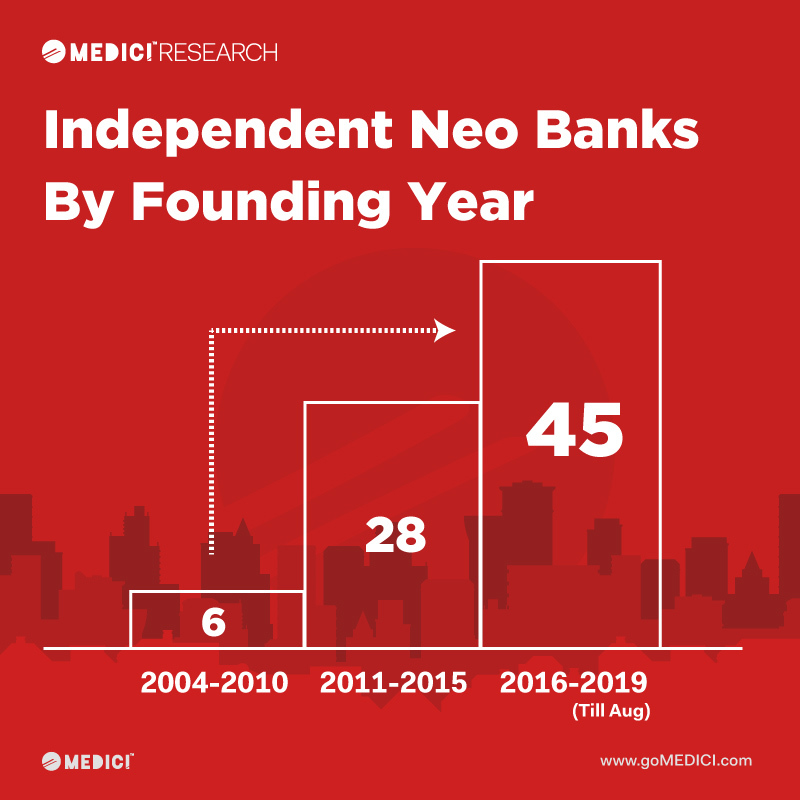
From 2004 to 2010, only 6 neobanks were founded. Between 2011 to 2016, that number rose to 28. And from 2016 to mid-2019, it spiked to 45


This data clearly shows that neobanks are gaining momentum, and a growing number of financial institutions will strictly operate online in the future.


How Can SMEs Use Neobanks?

Like we mentioned earlier, you can do many of the same things with neobanks that you can with traditional ones with physical branches. So SMEs can use them for everyday things like storing money in an online savings account and transferring funds. 

For instance, Xinja allows you to open an account in seconds and offers all of the essential features of a bank account and debit card without any ATM or account fees. It syncs with Apple Pay and Google Pay, allowing you to conveniently make business purchases. 

86 400 lets you open a “Pay Account” where you can also use Apple Pay and Google Pay, as well as Samsung Pay, Fitbit Pay, Visa Debit, and more. They also offer a “Save Account” where you earn 2.25% p.a. when you deposit at least $1,000 a month, making it a good option for business owners who are looking to build up their monetary reserves. 

You can also turn to neobanks for small business loans — a move that’s appealing to many SMEs given the often slow and meticulous nature of the traditional bank lending process. And considering traditional banks have collectively been more reluctant to hand out business loans ever since the 2008 financial crisis, many SMEs have a better chance of obtaining funding through a neobank.


The Pros of Neobanks

There’s a lot of excitement around this new form of banking, and understandably so. It offers many benefits, with the speed and simplicity of the platforms being one of the biggest. Neobanks are adopters of sophisticated, up-to-date technology, which can be a huge advantage for business owners. 

You can easily manage your finances from an online dashboard, even while you’re on the go. This means no more driving to the bank, filling out checks and invoices or waiting in line. As a result, you can stay on top of your business expenses and be notified whenever it’s time to make a payment from one convenient interface. On top of that, It can also be used to predict account activity, giving you a financial edge. 

Another advantage of neobanks is the level of transparency they offer. By having condensing all of your business’s financial information in one place, you always have a bird’s eye view of what’s happening, how much money is coming in and where your money is going. 86 400, for example, can connect accounts from over 150 financial institutions, which creates a full financial picture. 

They also tend to be low cost and don’t have as many fees as most traditional banks. With 86 400 there’s no:

  • Monthly account fee
  • Payments for using their app
  • Fees for domestic card payments
  • Fees for most ATM cash withdrawals
  • Replacement card fees

This is big when you’re a business owner looking to save anywhere you can. 

And when it comes to business loans, neobanks are quickly becoming a more desirable choice for SMEs because of how fast it is to apply and the increased odds of obtaining financing. “Businesses that applied to online lenders were “attracted by the speed of credit decisions, improved funding chances and lack of collateral requirements,” according to a 2017 Small Business Credit Survey by FED Small Business

So this is definitely something to keep in mind when you’re choosing between a neobank and a traditional one.


The Cons of Neobanks

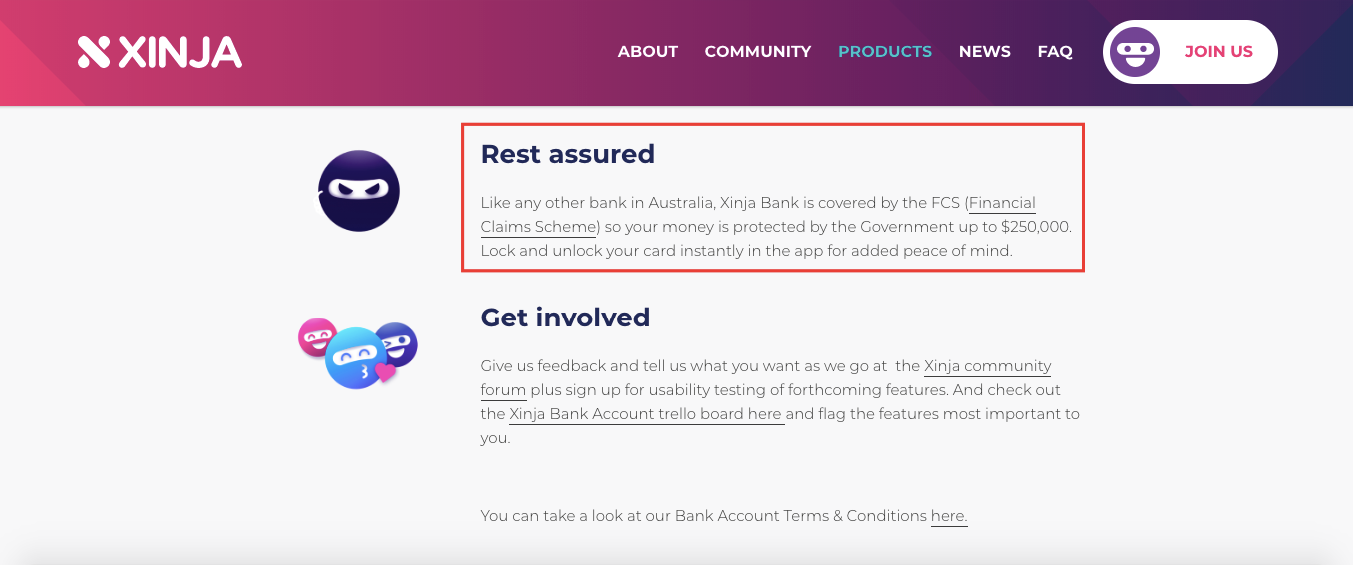
Perhaps the main drawback is that not all neobanks are covered under the Australian Government Guarantee Scheme, which guarantees deposits up to $250,000. If you happen to place your money in a neobank that’s not covered, you can potentially find yourself in a scary situation. That’s you should always ensure a neobank is covered by looking through their terms and conditions. 

For example, Xinja addresses this and specifically states that money is protected by the Australian government up to $250,000. 


The potential for technical issues can be another major problem for business owners. For instance, if an app or software malfunctions and there’s a serious glitch, it may be inoperable for a period of time, meaning you can’t access your banking. So any downtime on a neobank’s end can greatly hurt your business. 

There’s also a lack of laws and regulations surrounding this industry at the moment. We’re currently in a bit of a “wild west” stage where neobanks aren’t nearly regulated to the same extent that traditional banks are. This can create some concerns for SMEs because it may not always be obvious who’s responsible for a problem, and you won’t necessarily have any well-defined legal recourse. 

And considering that neobanks are 100% digital, they’re probably not a good choice for business owners who still value the human touch and prefer to speak with customer service reps face-to-face. While many platforms have adequate customer service, with some even offering it around the clock, it’s hard to reach the same level of customer service of traditional banks at the moment.


The New Frontier of Banking

Banking has evolved a lot over the 21st century, and neobanks are one of the newest manifestations of progress. Heavy investing is fueling their rapid growth, and this type of digital banking will only continue to catch on throughout the 2020s. 

Neobanks present some great opportunities for SMEs, mainly because their efficiency, transparency, low cost and potential as a business loan resource. However, SMEs should also be aware of the drawbacks and understand any issues that can arise. 

That way if you do decide to go this route, you’ll be well informed and shouldn’t have any major curveballs. 


Read more

What Type of Debtor Finance is Right for My Business?

25 October

Debtor finance is no longer seen by businesses merely as a simple stopgap measure for quickly getting on top of unplanned cash flow demands.

Increasingly, it’s being acknowledged as an effective means to sustainably foster business growth while minimising the effects of market volatility.

It’s also being embraced as a more flexible option than conventional bank loans and overdrafts — one which doesn’t require real estate as security and which imposes far fewer constraints in the form of loan conditions and covenants.

However, despite this growing trend toward debtor finance over traditional loans, there’s still a limited awareness of the various kinds of debtor finance that are out there. In a recent survey it was found that fewer than 5% of SMEs actively assess the suitability of tailored credit facilities.

As a result, while businesses may be benefiting from improved lines of credit, they may be missing out on tailored solutions.

In this guide, we’ll look at the advantages and disadvantages of debtor finance in its various forms. We’ll also explore the kinds of businesses to which each line of finance is best suited.

Debtor Finance

Debtor finance is a catch-all term for a kind of finance in which a line of credit is secured by accounts receivable. Essentially, it’s a means by which a business can borrow money against what they’re owed from their customers.

An Adaptable Solution That Can Be Used in Conjunction With Traditional Loans

The big benefit of debtor finance is that, unlike conventional loan arrangements, it has no requirement for real estate or facilitieIn addition to offering risk management advantages, debtor finance is a highly adaptable tool which can be used alongside conventional business borrowings without affecting their terms.

In addition to offering risk management advantages, debtor finance is a highly adaptable tool which can be used alongside conventional business borrowings without affecting their terms.

While typical debtor finance offers many advantages over conventional banking financing solutions, there may be more tailored options which fit the needs of specific businesses. 

Ideal Solution for Larger Businesses

Typically, debtor finance is best suited to medium to large businesses, with a turnover greater than $200,000.

For such companies equipped with their own accounts receivable department, debtor finance can be completely confidential, allowing the business to manage their own accounts receivable directly.

The following variations on debtor financing are similar to standard debtor financing in terms of their flexibility and the absence of a real estate securities requirement. However, they have unique additional features, making them a better choice for businesses facing specific growth and cashflow challenges.

Invoice Discounting

Invoice discounting is a form of short-term borrowing which is designed to improve a businesses’ cash flow position.

This is achieved by allowing a business to draw money against outstanding accounts receivable. It allows businesses to grow consistently, unhampered by a need to constantly wait for customer payments before further investing in expansion.

Flexible Line of Credit Which Grows With Your Company Sales Growth

One obvious and immediate benefit of invoice discounting is that credit limits are not fixed. Limits grow in line with business revenue, freeing a business up from the onerous requirement of ongoing loan re-negotiation.

If a sudden sales opportunity arises, an invoice discounting facility can cater for the increased cash flow needs, whereas a conventional loan would require re-negotiating its terms and conditions.

Factoring

Factoring refers to a service whereby a financial institution takes over the role of collections and chasing up on payments. The great benefit here for smaller business is that it frees them up to focus on growth rather than invoice management.

There are also potential downsides of this form of finance. Generally the amount you can access is capped at around 60% of revenue, although this can vary by institution. Scottish Pacific will pay up to 80% on approved invoices.

Furthermore, while factoring greatly increases a small businesses’ reach, it does generally mean the financial institution’s involvement is divulged to the customer. This may not be ideal in all circumstances.

An Ideal Finance Facility for Businesses Facing Rapid Sales Growth and Those Dealing With International Customers

Invoice discounting with Export factoring is ideal for businesses experiencing growth potential that is outstripping their growth capacity.

A business experiencing rapid sales growth is under pressure to rapidly capitalise on opportunities as they present themselves, and invoice financing affords that agility.

It’s also a great solution for businesses that are supplying goods or services on standard trade credit terms.
While trade credit terms are attractive for customers, without a suitable finance facility, there can be growth-hampering delays between issuing an invoice and receiving payment. Securing credit against pending invoices avoids that growth constraint.

Some non-bank finance providers offer export finance, which is the same package but geared toward international markets.

For example, Scottish Pacific’s export finance facility affords Australian businesses the flexibility to raise invoices to customers in over 20 approved countries.

Another advantage of this trade-friendly form of finance is that it can come with access to a specialist trade finance team, which permits SMEs to better traverse some of the risks inherent to international trade.

Selective Invoice Finance

Selective invoice finance is similar to invoice discounting. However, a key difference is that it is designed to be an on-demand service, used selectively and only when required.

Credit can be secured for relatively small invoice amounts, and can be secured against only one sales invoice, making it a great option for small businesses.

Once approved, this kind of finance is designed to permit rapid processing-times.

Scottish Pacific’s selective invoice facility typically has a processing time of less than 24 hours, with 80% of the value of the invoice then paid to the business and the remaining 20% released when the invoice is paid.

This facility works well when there’s a high exposure to a major debtor. There are no concentration restrictions with selective invoice finance. Scottish Pacific, for example, will approve 100% for a single debtor or major debtor balance.

Rapid, Flexible Credit on an Invoice by Invoice Basis

The overriding benefit here is in the flexibility that selective invoice finance affords. It allows a business rapid access to cash flow on an invoice by invoice basis.

It also limits unnecessary exposure to debt. SMEs are only paying for the finance they need and they are able to avoid the waste of paying non-usage fees and interest on unused borrowed funds.

A Solution Tailor-Made for Seasonal Businesses And Startups

Selective invoice finance is great for seasonal businesses.

Businesses with cash flow that fluctuates according to the time of year are unlikely to require a standing line of credit. In fact, for much of the year, such an arrangement would be an inefficient use of resources.

By accessing selective invoice finance, seasonal businesses are able to absorb sudden bursts in demand for additional working capital, without overextending. They’re effectively able to increase or decrease their cash flow on a sale by sale basis.

It’s also an ideal option for startup or exploratory businesses with at least 6 months trading history but who are unsure of the extent of the market they’re dealing with.

These kinds of businesses may be daunted at the prospect of committing to a long-term finance facility but a rapid, small-scale solution may afford the same advantages with less upfront financial commitment.

What Debtor Finance Works Best for You?

Debtor finance was once seen as a stopgap measure for handling unexpected cash flow challenges.

More SMEs are now embracing debtor finance as a tool which offers greater strategic growth potential than conventional loans.

Businesses with larger turnover are looking to debtor finance as a means of gaining cashflow without having to use real estate or facilities as security. They’re also using it to do business more favourably on trade credit terms.

Smaller businesses experiencing rapid growth are taking advantage of invoice discounting with factoring to hand over the role of collections and invoice management to a financial institution, greatly increasing their capacity to focus on their core businesses.

Seasonal and startup business enterprises stand to benefit greatly from the flexibility afforded by selective invoicing, with its quick processing times and low invoice amount requirements.

Whatever unique challenges your business is facing, it’s well-worth looking closely at the various forms of debtor finance that are available and choose the facility which works best for you.

What cash flow challenges is your business facing? If you’d like advice on the best debtor finance facility for your needs, you can contact a Scottish Pacific financial adviser here.

Read more
The late-payment epidemic: protecting your business as insolvencies rise

19 March

When late payments become a warning sign If you’ve noticed more customers paying late over the past year, you’re not imagining it. Four in five Australian businesses (80%) have experienced late or overdue payments in the past 12 months, and payment delays are averaging 25 days beyond agreed terms. That’s more than just frustrating – it’s a signal that something bigger is happening across the economy. […]

Read more

SME Growth Index Series: How Politicians Can Win the SME Vote

12 March

Our Scottish Pacific SME Growth Index is a twice-yearly snapshot of Australia’s small to medium sized business sectors showing cashflow issues that many businesses face today, below is the one of six key insights found in our March 2019 report: Over the past six years, the SME Growth Index has repeatedly highlighted that company tax […]

Read more

Overcoming Common Challenges in Securing Finance for Your Business

31 January

Securing finance can be a crucial step in the growth of small and medium sized enterprises. Whether you’re exploring more conventional business finance, tailored invoice finance solutions, trade finance to facilitate international trade or asset finance, knowing how to overcome common challenges in securing the capital you need is critical.  Overcoming the Top 9 Challenges […]

Read more

What Are Some Viable Financing Options for a Small Business?

1 July

Small businesses are Australia’s economic backbone. Recent research found, more than 99% of all Australian companies are small businesses, and they contribute $380 billion AUD to the economy. 

But one consistent issue these companies face is obtaining capital. Roughly a third of small businesses start with less than $7,200 AUD, and 58% start with less than $35,500. 

Knowing where to turn can you help secure the capital needed for your business to flourish. 

Here are some viable financing options: 


Grants and Assistance Programs 

One of the first avenues to explore is government funding. This isn’t necessarily an option for brand new startups, but it can potentially work if your growth is your focus. 

Visit the Grants and Assistance Programs section of Business.gov.au to get started. Enter information like your postcode, industry and business objectives, and you’ll see which programs you qualify for. 

Here’s an example. 


Click on the specific program you’re interested in, and you’ll get an overview, eligibility criteria and learn how to apply.

For instance, one small business grant program was specifically designed for helping Melbourne-based companies grow and was offering up to $30,000. 


Business Credit Cards

This is perhaps the most convenient option and provides you with a line of credit for funding your small business. While business credit cards may not be the right choice if you need a large amount of funding, it can certainly help fill in the gaps. 

They’re fairly easy to qualify for when compared to many other business loans and offer plenty of flexibility in terms of spending. Many offer rewards like cash back and travel points. They also give you a financial cushion so you can cover unexpected expenses as they arise. 

An added plus is business credits can help build your credit score as long as you consistently make payments on time. In turn, this can help you lock in better interest rates on future business financing options

The main drawback is that many come with high interest rates. If mismanaged, it can create a financial backlash that hurts your company. So you’ll want to thoroughly go over the details and make sure you understand the repayment terms. 

This guide from Small Business Loans Australia highlights 5 of the top business credit cards to check out. 


Secured Business Loans

These are collateral-based loans where you put up a valuable asset such as your car or home in exchange for financing.  

“What you choose to secure these business loans with, you’re essentially promising your lender that you’ll repay your loan,” says Fundera. If you aren’t able to repay your loan, the lender can use the collateralised assets or personal guarantee to legally recoup their losses.”

As a result, you need to be sure that you can repay a secured business loan in full and feel comfortable doing so. 

Here are the pros:

  • They often have lower interest rates than credit cards or lines of credit
  • You can usually obtain larger dollar amounts because they’re less risky for lenders (some offer up to $710,000 AUD)
  • Many have long repayment terms

Here are the cons:

  • You can’t obtain them unless you have a valuable asset
  • They come with a high level of risk (you could lose your home or car if you default)
  • They’re hard to get if you’re a new business and aren’t yet established 

To learn more about business loans and compare top providers, check out this resource from Finder


Crowdfunding

Crowdfunding is a relatively new concept that’s gained a lot of traction as of late. This is where a business raises capital through “the crowd” — a group of people who support your idea and make financial contributions to your company. 

This typically involves small amounts of money across a large group of people rather than just a large sum from a single investor. In exchange, backers usually receive some type of reward such as a pre-order of the product or branded merchandise. 

Those seeking crowdfunding launch a campaign with a specific timeframe. If funding targets are reached by the deadline, you receive the money and backers receive their reward. Otherwise, you won’t receive the funds and backers won’t be charged. In other words, it’s all-or-nothing. 

One of the main benefits of crowdfunding is that it’s low-risk. You’re not required to fulfill rewards unless your funding goal is met, and you don’t have to pay any money back like you would with business credit cards or a line of credit. 

You’re also not losing any equity in the process. Backers are essentially donating to your company, so you don’t have to give up an equity stake to investors — something that can be huge if you’re successful. 

On top of that, crowdfunding can give you some nice exposure. There have been instances where campaigns have went viral with brands basically becoming household names overnight. This makes it ideal if you’re a new startup looking to gain the attention of your target audience. 

The downside would be that it takes time and money to create a campaign, and there’s always the risk of failure. If your campaign goal isn’t met by the deadline, you won’t have anything to show for it. 

There are now hundreds of crowdfunding platforms to choose from. This list from Crowdfunding.com highlights some of the more popular ones.


Angel Investors

“Angel investor” is a catch-all term that applies to a private investor, seed investor or anyone with a large amount of capital who’s interested in providing funding to a business, usually in exchange for capital. 

Negotiations are made where both parties decide upon how big of an investment there will be and how much equity stake will be given away. Since an angel investor faces a high level of risk, they usually seek a high return on their investment — often 20 to 50% equity

Therefore, it’s not usually a good move if you’re looking to retain most of your equity. It can, however, be viable if giving up equity justifies the growth of your business.  

Going this route offers 2 main advantages. one, you can obtain a large amount of capital, with deals easily reaching six figures. This can ignite business growth and dramatically increase cash flow. You can purchase inventory, hire new employees, buy new equipment and reinvest in your company. 

The other benefit is the knowledge and expertise that comes along with an angel investor. Many are entrepreneurs themselves and know what it takes to successfully grow a company. Having them in your corner means you’ve got a valuable partner with a huge incentive to help your business. You may even be able to take advantage of their contacts to open even more doors. 

Check out Australia Angel Investors for a comprehensive list of over 1,400 potential investors. 


Invoice Finance 

Also known as debtor finance, this is a form of business financing that involves using your outstanding invoices as collateral. You simply upload the invoice you’ve sent to your client, get approval (up to 95% of the value of the invoice, often available within 24 hours) and receive a cash advancement. The remaining money becomes available once the invoice is paid in full. 

If slow or late-paying clients are the primary reason for your lack of cash flow, debtor finance is an effective solution. 

And many companies enjoy the flexibility that it offers. Debtor finance offers a full range of solutions to accommodate a variety of needs. 

There are full service facilities where the lender assumes responsibility for collections and tracks down payments. This works well if you don’t want to be burdened by the distractions of continually following up with slow-paying clients. 

There’s also an option for confidential facilities, which are ideal if you have a dedicated finance department and don’t wish to disclose the fact that you’re seeking financing to clients. Everything is still done in-house. You just receive a line of credit. 

There’s also Selective Invoice Financing where you only submit invoices you want funding against. You can submit just one invoice or multiple invoices whenever you need. This tends to work well if you only need occasional financing for an injection of working capital. Operating a seasonal company or needing to replace a piece of equipment are good examples. 

And unlike secured business loans, you don’t usually need to put up real estate or your vehicle with debtor finance. Your outstanding invoices are all you need. 


Weighing Your Options 

There are a lot of possibilities for small businesses seeking financing. You can go a more traditional route like business credit cards, grants or secured loans. Or you can take a newer approach like crowdfunding, angel investing or debtor finance.

What’s important is that you find viable financing options that meet your needs and you feel comfortable with. In other words, does it offer the funding you need and have reasonable repayment terms?

Examining each of the options listed above should provide you with the information you need to point you in the right direction. 


Do you have personal experience with any of these financing options? Give us a call to discuss these options further on 1300 505 883, or click here for us to get in touch.

Read more

The late-payment epidemic: Protecting your clients as insolvencies rise

17 March

When late payments become a warning sign If your clients have noticed more customers paying late over the past year, they’re not imagining it. Four in five Australian businesses (80%) have experienced late or overdue payments in the past 12 months, and payment delays are averaging 25 days beyond agreed terms. That’s more than just frustrating –  it’s a cash flow crisis in slow motion. And it’s creating […]

Read more

Choosing the Right Invoice Finance Provider: Questions to Ask

12 January

Finding the right Invoice Finance provider can help your business unlock previously inaccessible working capital. Invoice Finance can provide flexible, scalable, and cost-effective financial support to help your business better manage cash flow, invest in growth and fuel success. So, how do you find the best Invoice Finance providers? What questions should you ask? And how do different finance providers differ […]

Read more

5 Best Emergency Business Finance and Loan Options

30 July

Recent statistics regarding small and medium sized businesses in Australia indicate significant business finance and working capital-related concerns. 87% of small businesses in the country experience cash flow issues and – perhaps more shockingly – 34% of small business owners have had to forgo their own salaries as a result. In the best-case scenario, SMEs […]

Read more